
Object Record
Images
Metadata
Catalog Number |
2017.030.001 |
Object Name |
Cabinet |
Title |
Walter Prince Kreigner's Cabinet with Drawers |
Description |
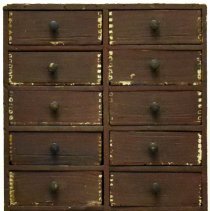
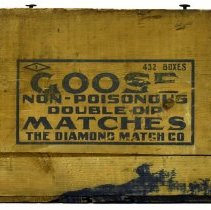
The object is a dark brown cuboid-shaped cabinet with thirteen drawers on the front. The drawers are arranged vertically in pairs of two, except for the bottom, which consists of one long drawer. Each of the twelve drawers above the bottom drawer has a single black circular metal knob near its center for pulling open. The bottom drawer has two metal knobs, one on each side. Most of the drawers have embossed inscriptions that are illegible. Inside the cabinet, there is a brown inscription that appears to be burned into the wood, reading: "WALTER P. KREIGNER. MAY, 1919. Trenton, N.J." The backs of the drawers feature inscriptions advertising various shoeshine and matchbox companies. Some of the logos include Oiline (4), Shuwite (2), S.M. Bixby & Co. (2), and Geo. A. Moss (4). The only drawer without an advertisement on the back is the bottom one. The top and bottom of the left and right sides, as well as the edges of the top and bottom, have indented rectangles. The bottom of the cabinet has a blue inscription reading: "432 BOXES. GOOSE NON-POISONOUS DOUBLE DIP MATCHES. THE DIAMOND CO." Above the inscription, there is a blue diamond with an "I" inside it, and both the inscription and diamond are framed by a blue rectangle. The cabinet comes with a series of notes. The first note reads, "Walter Prince Kreigner at 918 New Willow Street in Trenton. While we dont know much about him yet, we do know that he could think "outside the box." After returning from the army during World War I, he created this small chest of drawers out of wooden crates. If you look closely, you can see the imprint of the company's name under the paint on the fronts of some of the drawers. Name of the shoe shine and match boxes are more easily seen on the backs of the drawers. Look inside the cabinet and you can see where he wrote his name, town and date. This box is truly a great example of "folk art" and "upcycling." What do you or your relatives recycle into other more useful things? Gift of Nancy A. Kriegner, great-niece, November 2017." The second note reads, "Walter Kreigner enjoyed building things such as this milk box. Home milk delivery from local dairies was standard for many families in the mid-20th century. The milk man faded away when it became easier and cheaper to buy milk at the grocery store. Also on display are some of the tools Walter used for his various projects." And the third and final note reads, "Walter Prince Kreigner lived at 918 New Willow Street in Trenton. After returning from the army during World War I, he created a small chest of drawers out of wooden crates. Look closely and the imprint of the company's name under the paint on the fronts of some of the drawers can be seen. Names of shoe shine and match boxes are more easily seen on the back of some of the drawers. Inside the cabinet is where he wrote his name, town, and date. Gift of Nancy A. Kriegner, great-niece, November 2017." In addition to the notes, the object also comes with various pictures of the crates, Walter Prince Kreigner's house, and Walter Prince Kreigner himself. |
Date |
1919 |
Material |
Wood and Metal |
Artist |
Walter Prince Kreiger |
Height (in) |
22.500 |
Length (in) |
16.250 |
Width (in) |
10.250 |
Condition |
Poor |
Condition Notes |
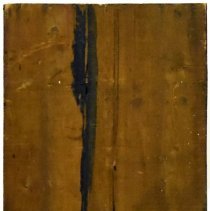
Overall: Abrasions, accretions, corrosion, scratches, and cracking throughout. Front: The embossed inscriptions are faded. There are white accretions on the sides of the drawers. The is corrosion on the knobs. There seems to be screws missing on the top and bottom. There is paint chipping along the top and bottom. There are multiple holes on the on the drawers. And finally, there are abrasions on the top left and top right corners. Right Side: There is corrosion all over the nails. There are scratches on the center near the middle. There is a large crack on the right side. There is paint chipping near the upper right corner. There are white accretions near the top right corner. And finally, there is a black vertical accretion on the bottom near the right side. Back: There are two large cracks near the middle. There is a smaller crack near the right side. There is a large blue accretion all over the middle. There are white accretions on the bottom. There is corrosion all over the nails. And finally, there is a missing nail on the left side near the center. Left Side: There are two large cracks on the right and left sides. There are scratches on the left side. There are white accretions all over. There is corrosion all over the screws. And finally, there are abrasions all over. Top: There are two large cracks near the center. There are abrasions all over. There is corrosion all over the screws. And finally, there are white accretions on the bottom. Bottom: There is a large crack on the bottom. There is a large blue accretion on the bottom. There is a light brown discoloration all over. There are black accretions all over. The logo is chipped.There is a white accretion near the top left corner. And finally, there are scratches near the top right corner. |
Inscription Type |
Inscription |
Inscription Location |
Front Inside, Left, Top to Center |
Inscription Technique |
Stamped |
Inscription Text |
"Walter P." Line 1 "Kriegner" Line 2 "May, 1919" Line 3 "TRENTON," Line 4 "N.J" Line 5 Bottom, Center, Middle "432 BOXES" Line 1 "GOOSE" Line 2 "NON POISONOUS" Line 3 "DOUBLE DIP" Line 4 "MATCHES" Line 5 "THE DIAMOND MATCH CO." Line 6 |
People |
Walter Prince Kreigner |
Classification |
Domestic Life/Household Goods |
Subjects |
Wood Wood carving Matches Cabinets (Case furniture) Cabinetmaking Shoe shiners Shoe shining Shoe polishes Shoe industry |
Search Terms |
Wood Cabinet Brown Oiline Walter Prince Kreigner Nancy A. Kreigner Matches Shoe Shine Drawers Shuwite S.M. Bixby & Co. Geo. A. Moss 1919 20th Century World War I Trenton New Jersey NJ May Matches Match Boxes Shoe Shines New Willow Stree |
Provenance |
This item was donated to the Trenton Free Public Library by Nancy A. Kreigner. It became part of the Museum Collection in November of 2017. |