
Object Record
Images
Metadata
Catalog Number |
2020.FIC.119 |
Object Name |
Vase |
Title |
Stangl Pottery Orange Vase |
Description |
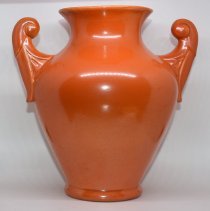
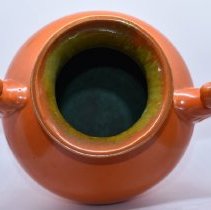
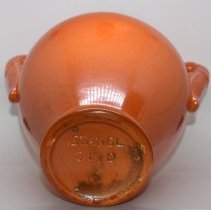
The vase is orange and cylindrical, with two handles on either side. At the base, it starts relatively narrow and gradually widens as it ascends. Once it reaches the upper middle, it sharply tapers again toward the top. The handles are slightly curved, resembling gentle waves. The top of the vase is open, revealing its greenish-blue interior. On the bottom, the words "STANGL" and the number "3110" are stamped. According to Stanglpottery.org. Hill Pottery originally began in 1814 in Flemington, New Jersey. Samuel Hill, the original owner and namesake of the company, produced drain pipes, storage crocks, and jars using earthenware clay. Abram Fulper acquired the company in the 1860s and the company's name eventually changed to Fulper Pottery by 1900. Abram began to use stoneware, rather than earthenware. William H. Fulper II, the grandson of Abram Fulper, hired Martin Stangl in 1910 to help produce shapes and glazes. By 1924, Martin Stangl became Vice President of the company. In 1926, a larger factory was bought in Trenton from Anchor Pottery. After Fulper's death in 1928, Stangl became the president of the company. Around this time, items created by Stangl began to be marked by the inscription "Stangl" or "Stangl USA." In 1929, the original factory in Flemington burnt down which caused Stangl to move all production to the two new factories. By 1935, all production ceased at the Flemington location and it was used solely as a retail storeroom. By the 1940s Stangl's hand printed dinnerware became extremely popular. By 1955, the company's name was changed to Stangl Pottery. According to Susan Eastman of the Herald Times, Stangl created the first open stock solid-color dinnerware in America. Stangl also created the practice of demonstrating pottery in public places, like department stores. Stangl heavily emphasized the practice of "jobbing," or creating ceramic parts for other companies. Stangl was also an innovator in VaseKraft, a type of brightly colored vases. Stangl pottery closed in November 1978. Citations: Eastman, S. (2019, August 23). HT.Stangl Art Pottery. Times. https://www.heraldtimesonline.com/story/lifestyle/home-garden/2019/08/23/htstangl-art-pottery/46939119/ Stangl Pottery Flemington New Jersey. (n.d.). https://stanglpottery.org/ |
Year Range from |
1929 |
Year Range to |
1978 |
Material |
Ceramic |
Artist |
Stangl Pottery |
Height (in) |
7.000 |
Length (in) |
7.500 |
Diameter (in) |
6.000 |
Condition |
Good |
Condition Notes |
Overall: Accretions, dirt, abrasions, and discolorations throughout. Front: In the upper right quadrant, there is a black accretion that is 1" from the left edge and 2 1/4" from the top. There is a white accretion that is 1 1/2" from the left edge and 2 3/8" from the top. There is a black accretion that is 2" from the left edge and 2" from the top. There is a white accretion that is 2 3/4" from the left edge and 1 3/4" from the top. There is a black accretion on the left edge that is 1 1/4" from the top. There is a black accretion on the left edge that is 1 3/4" from the top. There is a black accretion that is 1 1/2" from the left edge and 3" from the top. And finally, there is an abrasion that is 1 1/2" from the left edge and 3" from the top. In the upper right quadrant, there is a white accretion that is 3 1/4" from the right edge and 2 1/8" from the top. Also, there are three small abrasions that are 2 1/2" from the right edge and 1 7/8" from the top. In the lower right quadrant, there is a black accretion that is 2" from the right edge and 2 3/4" from the bottom. There is a black accretion that is 1 1/2" from the right edge and 1/2" from the bottom. In the lower left quadrant, there is nothing of note. Right side: In the upper left quadrant there are two black accretions that are 2 3/4" from the left edge and 1/2" from the top. In the upper right quadrant, there is a black accretion that is 2 3/4" from the right edge and 1 3/4" from the top. Also, there is a small black accretion that is 3" from the right edge and 5/8" from the top. In the lower right and left quadrant, there is nothing of note. Back: In the upper left quadrant, there is an abrasion that is 2 1/2" from the left edge and 1 1/4" from the top. There is an abrasion that is 1" from the left edge and 3 1/4" from the top. And finally, there is a dirt accretion that is 2 3/4" from the right edge and 1 1/2" from the top. In the upper right quadrant, there is an abrasion that is 1 3/4" from the right edge and 2 1/2" from the top. There is a black accretion that is 1 1/4" from the right edge and 2 1/2" from the top. And finally, there is an abrasion that is 1 1/4" from the right edge and 1 1/2" from the top. In the lower right quadrant there is an abrasion that is 2 1/2" from the right edge and 2" from the bottom. In the lower left quadrant, there is an abrasion that is 3 3/4" from the left edge and 3 1/4" from the bottom. There is a little bit of paint chipping that is 3 1/4" from the left edge and 1 1/2"from the bottom. And finally, there is a dirt accretion that is 1 1/2" from the left edge and 2" from the bottom. Left Side: In the upper left and right quadrants, there is nothing of note. In the lower right quadrant, there is an abrasion that is 2 3/4" from the right edge and 1/4" from the bottom. In the lower left quadrant there is a black accretion that is 1 3/4" from the left edge and 1/2" from the bottom. Top: Across all four quadrants, there is dirt inside the vase. Bottom: In the upper left quadrant, there is a brown and yellow discoloration all across the rim of the base. There is a brown and yellow accretion 3" from that is 3" from the left edge near the top of the base. In the upper right quadrant, there is a brown and yellow discoloration all across the rim. In the lower right quadrant, there is a large brown and yellow discoloration that starts 2 1/2" from the right edge and goes until 5" from the right edge and starts 3 1/4" from the top and goes until 1/2" from the bottom. In the lower right quadrant, there is an abrasion that is 3 1/4" from the left edge and 1 1/2" from the bottom. |
Inscription Type |
Manufacturer's Mark |
Inscription Location |
Bottom, Top, Middle |
Inscription Technique |
Etched |
Inscription Text |
"STANGL" Line 1 "3110" Line 2 |
People |
Martin Stangl William Fulper II Abram Fulper Samuel Hill |
Classification |
Domestic Life/Household Goods Business & Commerce |
Subjects |
Vases Ceramic industry Decorations |
Search Terms |
American Pottery Orange Stangl Ceramic Vases Yellow Blue Handle 1929 1978 20th Century Handle Trenton Flemington New Jersey Ceramic Martin Stangl William Fulper II Abram Fulper Samuel Hill Stangl Pottery Hill Pottery Fulper Pottery Stangl Pottery Orange Vase |
Provenance |
Found in collection. |