
Object Record
Images
Metadata
Catalog Number |
2024.FIC.007 |
Object Name |
Wheel |
Title |
John A. Roebling's Sons Company Small Wire Wheel |
Description |
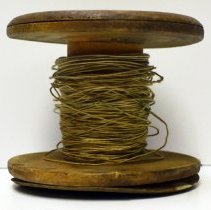
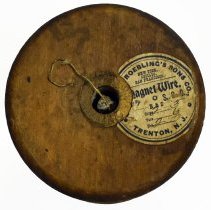
This brown, cylindrical wooden wheel is wrapped with silver metal wire. The top and bottom of the wheel consist of two wide circular discs, while the middle portion is a relatively thin cylinder, around which the wire is tightly wrapped. On the top of the wheel, there is a circular hole that goes all the way through to the bottom, with a small bit of wire protruding from the top of the hole. To the right of the hole is a yellow, circular sticker from John Roebling's Sons Company. The sticker features a black inscription that reads: "ROEBLING'S SONS CO. NEW YORK. CHICAGO. SAN FRANCISCO Magnet Wire. O S.O.O. B&S Gross 2-3. Tare 6. Net 2-7. TRENTON, N.J." The portion of the inscription reading "2-3. 6. 2-7." is written in ink. The entire inscription is enclosed in a black circle. The sticker is torn on the left side, making part of the text illegible. According to the Trenton City Museum, John A. Roebling founded the John A. Roebling's Sons Company in 1841. Initially based in Saxonburg, Pennsylvania, the company moved to Trenton, New Jersey, in 1848 and later opened an additional factory in Roebling, New Jersey, in 1905. The company became widely known for its manufacturing of wire rope, which was used in suspension bridges, elevators, cable cars, tramways, airplanes, shipping, mining, construction, ski lifts, electrical lines, telegraphs and telephones, wire cloth and screens, and pre-stressed concrete. Roebling's wire rope was integral to the construction of famous bridges such as the Brooklyn Bridge, the George Washington Bridge, and the Golden Gate Bridge. For many years, the Roebling family business was one of the largest employers in the city of Trenton. In 1953, the family sold the plants to the Colorado Fuel and Iron Company. The Trenton plant closed in 1973, and the Roebling plant followed shortly after in 1974. John Roebling, born June 12, 1806, in Muehlhausen, Prussia, immigrated to America in 1831. He initially joined a farming colony in Saxonburg, Pennsylvania, but, realizing he was ill-suited for farming, he transitioned to part-time surveying and construction work. By the late 1840s, Roebling had achieved considerable success, allowing him to move his operation to Trenton. His international reputation grew with the construction of the Niagara Bridge in 1855. After the American Civil War, Roebling expanded his operations and brought his sons into the business. Towards the end of his life, he began drafting plans for the Brooklyn Bridge, though he passed away in 1869 before its completion. The Brooklyn Bridge would go on to become the longest suspension bridge of its time. Citations: John A. Roebling’s Sons Company - Trenton City Museum. Trenton City Museum . (2016, May 6). https://ellarslie.org/john-a-roebling-sons-company/ John Augustus Roebling. American Society of Civil Engineers. (n.d.). https://www.asce.org/about-civil-engineering/history-and-heritage/notable-civil-engineers/john-augustus-roebling |
Year Range from |
1841 |
Year Range to |
1973 |
Material |
Wood, Metal |
Artist |
John A. Roebling's Sons Company |
Height (in) |
3.750 |
Diameter (in) |
4.375 |
Condition |
Okay |
Condition Notes |
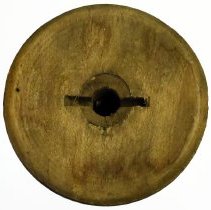
Overall: Corrosion and discolorations throughout. The wooden circles are coming apart at numerous points. Front: There is corrosion all over. There is a green discoloration on the center of the wire near the middle. And finally, the wooden circle on the bottom is coming apart near the middle. Right Side: There is corrosion all over. The wooden circle on the bottom is coming apart near the middle. There is a green discoloration all over the wire. And finally, there is a white accretion on the bottom near the middle. Back: There is corrosion all over. The wooden circle on top is coming apart near the middle. And finally, the wooden circle on the bottom is coming apart near the middle. Left Side: There is corrosion all over. The wooden circle on top is coming apart near the middle. There is a green discoloration on the center of the wire near the middle. And finally, the wooden circle on the bottom is coming apart near the middle. Top: There is corrosion all over. There are two black accretions on the top and bottom of the left side. There is a dark brown discoloration all over the right side. The sticker is torn on its left side. And finally, there are many small tears all over the sticker. Bottom: There is corrosion all over. There is an abrasion on the center near the left side. And finally, there is a dark brown discoloration on the bottom near the middle. |
Inscription Type |
Inscription |
Inscription Location |
Top, Center, Right Side |
Inscription Technique |
Stamped |
Inscription Text |
"ROEBLING'S SONS CO.," Line 1 "NEW YORK." Line 2 "CHICAGO." Line 3 "SAN FRANCISCO." Line 4 "Magnet Wire." Line 5 "O S. O. O" Line 6 "B&S" Line 7 "Gross 2-3" Line 8 "Tare 6" Line 9 "Net 2-7" Line 10 "TRENTON, N.J." Line 11 |
People |
John Roebling Ferdinand Roebling |
Classification |
Business & Commerce |
Subjects |
Bridge construction Brides Metals Metalwork Metalworkers Metalworking |
Search Terms |
Wood John Roebling Roebling Roeblings John A. Roebling's Sons Company New York Chicago San Francisco Trenton New Jersey NJ Wheel Metal Wire 1841 1973 19th Century 20th Century Brown Silver Gross 2-3 Tare 6 Net 2-5 Magnet Wire B&S O S.O.O Wheel John A. Roebling's Sons Company Small Wire Wheel |
Provenance |
Found in collection |