Object Record
Images
Metadata
Catalog Number |
2023.034.001 |
Object Name |
Plate, Commemorative |
Title |
Mercer Pottery Company 250th Anniversary of Trenton Commerative Plate |
Description |
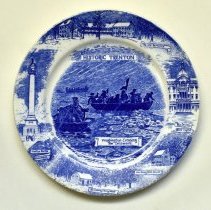
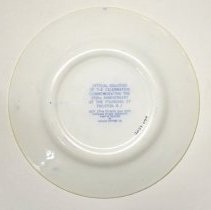
This blue and white circular plate features various historical images related to the city of Trenton. All of the images are rendered in blue and white, with the central image depicting George Washington and his troops crossing the Delaware River. Two inscriptions are found on this image: one at the top reading, "HISTORIC TRENTON," and another at the bottom reading, "Washington Crossing the Delaware." In this central scene, there are three boats on a body of water. The first, closest to the viewer, is partially visible and includes a man holding an oar standing next to a cannon with large wheels. The second boat, positioned on the right, shows several men-one holding a flag and five holding oars-all wearing hats. The third, distant boat shows a group of men whose features are barely visible. The plate's edge is adorned with additional historical scenes. At the top is an image of The Old Barracks, with a small inscription at the bottom right corner reading, "The Old Barracks." The buildings are arranged in a "U" shape, all two stories high, with most having a second-story deck, except for the building on the far right. Leafless trees are visible in front of the barracks. To the right of the Old Barracks is an image of the New Jersey Statehouse. Beneath the image, an inscription reads, "New Jersey State Capital." The visible portion of the Statehouse features a three-story structure with Roman-style columns, windows in pairs on either side of the columns, and a large dome above. The upper part of the building, including a half-circle design, is partially obscured. Below and to the left of the Statehouse is an image of the Douglass House, viewed from the right side. The two-story building has a small deck on the left side and an additional small structure attached to the right side. There are trees without leaves behind the house. To the left of the Douglass House is an image of the McConkey Ferry House, a one-story building with numerous leafless trees behind it. At the upper left corner, there's an image of the Trenton Battle Monument, with an inscription beneath it reading, "Trenton Battle Monument." The monument is depicted with a pedestal, a tall pillar, and a statue of George Washington on top. The front of the plate is slightly caved in, creating a slight elevation at the back. The back of the plate features a slight rim separating the base from the rest of the back. In the center, there is a blue inscription that reads: "OFFICIAL SOUVENIR OF THE CELEBRATION COMMEMORATING THE 250th ANNIVERSARY OF THE FOUNDING OF TRENTON. NJ. OCT. 27TH TO NOV. 2ND 1929. SKETCHINGS BY GEO. BRADSHAW. MADE IN TRENTON. BY MERCER POTTERY CO." According to Edwin Atlee of the Trenton Historical Society, the Potteries of Trenton Society, and the book Mains and Fitzgerald's Trenton, Chambersburg, and Millham Directory, Mercer Pottery operated in Trenton from around 1865 or 1868 until either the 1930s or 1946. By 1875, James Moses owned the company and claimed to have developed the first semi-porcelain ware in the United States. According to National Geographic, George Washington led his troops across the Delaware River on the night of December 25th, 1776. Washington's target was about 1,400 Hessian troops stationed in Trenton, New Jersey. Washington crossing the Delaware was supposed to be a part of a larger attack with two other crossing's planned, but only Washington and his men were able to successfully reach the Hessians. Washington's ships were between 12 to 18 meters in length. Washington and his men were forced to endure harsh rain, sleet, and snow during their crossing. Due to British spies in Washington's camp, the Hessians were aware that Washington may have been planning attack them. Nevertheless, the Washington and the Americans were victorious and captured the Hessians before the morning. According to the Old Barracks Museum, the Old Barracks were initially built in 1758 due to residents complaining that troops were being quartered in their home during the French and Indian War. During the American Revolutionary War, British and Hessian troops briefly stayed at the Old Barracks prior to the Battle of Trenton. During the Battle of Trenton itself, loyalist colonist stayed at the Old Barracks in order to be protected from American soldiers. After Washington took Trenton, the Old Barracks were used as an army hospital. After the war was over, a large portion of the Barracks were demolished to extend Front Street. The Old Barracks Association bought the south section of the Old Barracks in 1902. The state of New Jersey bought the north section of the Old Barracks in 1914 and transfered it to the Old Barracks Association with the intension of turning it into a museum. As of 2024, the Old Barracks have been a museum for over 100 years. According to the New Jersey State House Tours website, the New Jersey State House was initially built in 1792. The building was initially two and a half stories high. The Senate (which was originally called the Legislative Council) was located in the west of the building and the General Assembly was located in the east. The governor and various judicial officials were located on the second floor. In 1845, an office wing was added to the north side of the building and a large spherical dome was added on top. In 1871, a new wing was designed for both legislative offices. The old Senate Chamber became the governor's new office and the Assembly chamber became various different offices. In 1885, a fire caused them to add a new rotunda and a new dome. In 1891, the Assembly was redesigned in a Victorian style, and in 1903, the Senate was redesigned in an American Renaissance style. In 1987, new office space was added. And from 2017 until 2023, the front of the State House was closed for renovations. According to Crossroads of the American Revolution, the Douglass House was the home of Alexander Douglass. Douglass was the Quarter Master of the Continental during the American Revolutionary War. George Washington used this house as his headquarters during the Second Battle of Trenton. Washington held a meeting with his top officers at this house and came up with the plan to escape Trenton before British General Cornwallis attacked in the morning. This led to the Battle of Princeton. According to the Daughters of the American Revolution and the Washington Crossing Website, The McConkey ferry was used to transport military equipment across the Delaware River during the Battle of Trenton. The first ferry was built on this site by the Baker family in 1752. The Baker family sold the site to Samuel McConkey, who was the owner of the site in 1776. George Washington and his aides stayed at the tavern near the ferry. Much of the current Inn was built in 1792. Today, the ferry house is a part of the Washington Crossing National Historic Park. According to the state of New Jersey's website, the Trenton Battle Monument was designed to honor George Washington's victory over the Hessian Soldiers in the Battle of Trenton during the American Revolutionary War. During the Battle of Trenton, General George Washington led his troops across the Delaware River to surprise the troops garrisoned in Trenton on December 26th, 1776. After a series of defeats, the Battle of Trenton is considered a seminal moment is America's ultimately successful bid to achieve independence from the British Empire. The cornerstone of the monument was laid on December 26, 1891, 115 years after the battle took place. The monument was officially dedicated on October 19, 1893, 112 years after British General Cornwallis surrendered to General George Washington at Yorkstown, Virginia. John H. Duncan designed the monument and William O'Donovan contributed the statue of George Washington. The monument stands 148 feet high and is made of granite in a Roman-Doric style. As of 2024, the monument is open to the public during daylight hours. Citations About the Building. Old Barracks Museum. (n.d.). https://www.barracks.org/about-the-building.html Alexander Douglass House – Trenton, NJ. Crossroads of the American Revolution. (n.d.). https://revolutionarynj.org/storyline_photo2/alexander-douglass-house-trenton-nj/ Barber, E. A. (n.d.). Marks of American potters. Trenton Historical Society, New Jersey. https://www.trentonhistory.org/Made/Marks.html Building History. New Jersey Legislative Services, NJ. (n.d.). https://www.njstatehousetours.org/171/Building-History George Washington Crosses the Delaware. National Geographic. (n.d.). https://education.nationalgeographic.org/resource/george-washington-crosses-delaware/ The Historic Village: Washington Crossing Historic Park. Washington Crossing Historic Park |. (2021, August 3). https://www.washingtoncrossingpark.org/park/the-village-lower-park/ Mains, Bishop W. and Thomas F. Fitzgerald. 1877-1879. Mains and Fitzgerald’s Trenton, Chambersburg and Millham Directory: Containing the Names of the Citizens, Statistical Business Report, Historical Sketches, a List of the Public and Private Institutions, Together with National, State, County, and City Government. Bishop W. Mains & Thomas F. Fitzgerald, Trenton, New Jersey. McConkey Ferry Inn. Daughters of the American Revolution. (2018, October 23). https://www.dar.org/national-society/historic-sites-and-properties/mcconkey-ferry-inn Mercer Pottery. Potteries of Trenton Society. (n.d.-c). https://potteriesoftrentonsociety.org/research/records/mercer-pottery-2/ State of New Jersey. (n.d.). Trenton Battle Monument Historic Site Overview. Official Site of the State of New Jersey. https://nj.gov/dep/parksandforests/historic/trentonbattlemonument.html |
Date |
1929 |
Material |
Ceramic |
Artist |
Mercer Pottery Company |
Diameter (in) |
9.000 |
Condition |
Good |
Condition Notes |
Overall: Nothing in the front. Abrasions and accretions all over the back. Front: There is a green accretion on top near the middle. Back: There are abrasions around the edges. There are blue accretions around the edges. There are blue accretions around the inner rim. There is paint cracking all over. And finally, the inscription is faded. |
Inscription Type |
Inscription |
Inscription Location |
Front, Top to Bottom, Left to Right |
Inscription Technique |
Stamped |
Inscription Text |
"The Old Barracks" Line 1 "HISTORIC TRENTON" Line 2 "New Jersey" Line 3 "State Capital" Line 4 "Washington Crossing" Line 5 "The Delaware" Line 6 "Trenton Battle" Line 7 "Monument" Line 8 "The Douglas House" Line 9 "McConkey Ferry House" Line 10 Maker's Mark Stamped Back, Center, Middle "OFFICIAL SOUVENIR" Line 1 "OF THE CELEBRATION" Line 2 "COMMEMORATING THE" Line 3 "250TH ANNIVERSARY" Line 4 "OF THE FOUNDING OF" Line 5 "TRENTON. N.J." Line 6 "OCT. 27TH NOV. 2ND 1929" Line 7 "SCETCHINGS BY GEO BRADSHAW" Line 8 "MADE IN TRENTON" Line 9 "MERCER POTTERY" Line 10 |
People |
James Moses George Washington Thomas Maddock John H. Duncan William O'Donovan Alexander Douglass Samuel McConkey Geo Bradshaw Henry W. Comfort John Pierce |
Classification |
Historic Sites Domestic Life/Household Goods Business & Commerce People |
Subjects |
Ceramic industry Historic Sites War War allies Water Generals Military officers Boats Boathouses Monuments & memorials Monument builders Monuments Domes |
Search Terms |
Ceramic White Laura Poll Blue Delaware River Old Barracks House Buildings Trenton Trenton Battle Monument House Douglas House New Jersey State Captial State Assembly Crossing James Moses George Washington Thomas Maddock John H. Duncan William O'Donovan Alexander Douglass Samuel McConkey Boats Flag Cannon 1929 20th Century 1776 18th Century Geo Bradshaw 250th Anniversary Commemorative Plate Trenton Mercer Pottery Company McConkey Ferry House Revolutionary War French and Indian War Geo Bradshaw James Moses Mercer Pottery Company 250th Anniversary of Trenton Commerative Plate |
Provenance |
This item was donated to the library by Laura Poll. It became apart of the Museum Collection in November of 2023. |